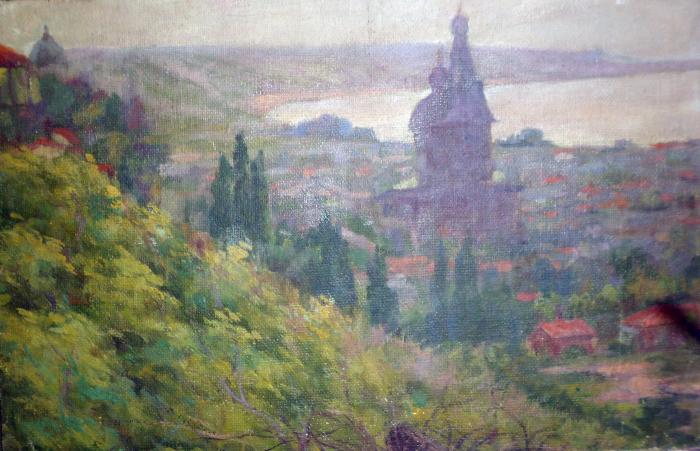
Mariupol, Italian Street
- ID:
- 1069
- Inventory number:
- Гр-382 КН-12573
- Type:
- Graphics
- Material:
- paper
- Techniques:
- watercolor
- Dimensions:
- 29.8x21.5 cm
- Author:
- Andrii Petus
-
Andrii Yukhymovych Petus was a Ukrainian painter, graphic artist, and a member of the Ukrainian Union of Artists starting in 1945. Born on June 2 (14), 1884 in the city of Borzna, Chernihiv province (now Chernihiv region, Ukraine), he graduated from the painting department of the Kyiv Art School (1914; his teachers were M. Pimonenko, V. Menk, F. Krychevskyi, and H. Diadchenko). He visited the studio of O. Murashko. From 1915 to 1922, he taught drawing in secondary schools in Mariupol. He was a member of the Mariupol Association of Artists. Petus was one of the organizers of the Mariupol Museum of Local Lore. From 1922 to 1935 and 1949 to 1950, he taught drawing in secondary schools and the pedagogical college of Chernihiv. He created portraits and landscapes in a realistic style. He made illustrations for "Little Kobzar" by T. Shevchenko (Mariupol, 1920). Petus was a participant in regional and all-Ukrainian art exhibitions starting in 1917. His personal exhibitions were held in Chernihiv (1974, 2004, 2014; all anniversary exhibitions). His main works include "Sister", "Portrait of a Girl" (both - 1912), "Lesya" (1917), "March" (1926), "Mothers" (1946), and "Peonies" (1954). Some of his works are kept in the Chernihiv Art Museum, and were also kept in the Mariupol Museum of Local Lore. He died on December 26, 1958 in Chernihiv.
- Date of creation:
- 1919
- Preservation:
- Paper, paints faded. There are scuffs, dirt. To the right of the center - a round hole in the paper: d - 0.5 cm.
- Location:
- unknown
- Provenance:
- Recorded in the inventory on 11/20/1967. Source of income is not specified.
- Date of record to the inventory book:
- 09.11.1981