
Return to collection
Fine Art
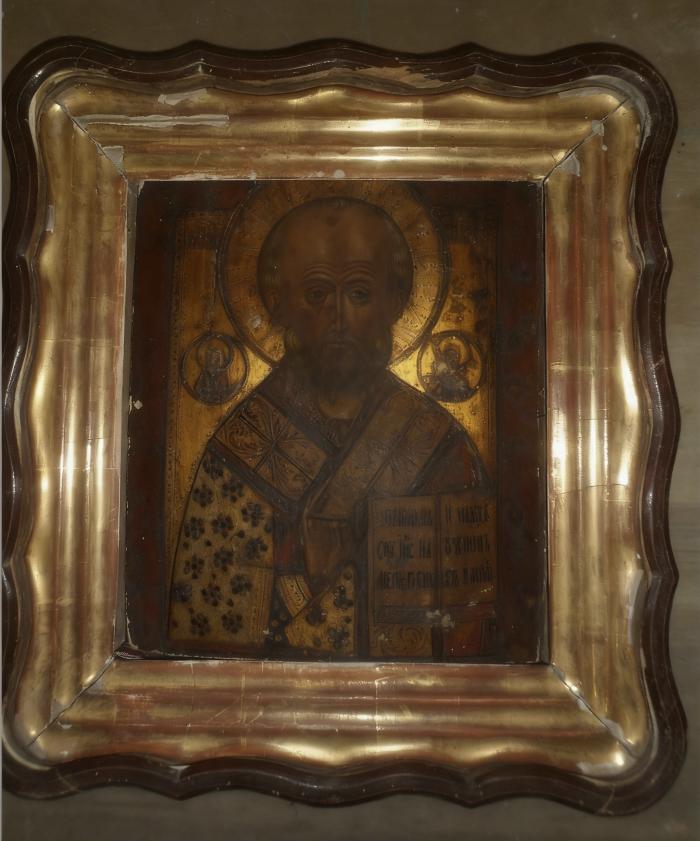

Icon “Saint Nicholas the Wonderworker” in a Riza and Kiot
- ID:
- 498
- Inventory number:
- Ж-497 КН-43089
- Type:
- Paintings
- Material:
- board, silver
- Techniques:
- levkas, oil, iconography, embossing
- Dimensions:
- 30x35 cm
- Date of creation:
- 1848
- Preservation:
- Edges trimmed, partially repainted. Loss of paint layer. Gilding on frame worn off. Kiot without glass. Keys missing.
- Belongs to a special collection:
- Yes
- Location:
- unknown
- Provenance:
- Chetenov Ye.V. Act No. 56 dated 05/27/1991.
Item description from the inventory book:
The image is half-length, frontal. He blesses with his right hand, but the position of the fingers is unusual; on his left he holds the open Gospel. The phelonion is golden with flowers made of black and brown dots. The omophorion is light brown with a wide red border and crosses outlined in black, as well as with floral patterns. The sleeve of the chiton is black with golden dots; there is an ornament of embossed dots on the shoulder and along the edge of the phelonion. The same ornament covers the halo and the edges of the background of the icon. The face is painted in a brown tone with darker paint with light highlights. The strands of hair and beard are made with light brown lines. The background, as well as the halo and phelonion, are imitation gilding. The fields are wide and brown. The inscription at head level: "OBRA. ST... NIK...4Y" On the opened Gospel the text: "OVER... IT IS SOUND. JES IS IN PLACE, EQUAL AND THE PEOPLE TEACHING HIM AND PLENTY." In the medallions: on the left is depicted I. Christ with the Gospel in his hands; on the right is the Mother of God with an omophorion. The medallions demonstrate the so-called “Nicene miracle”: according to legend, during the Council of Nicaea, Nikolas, outraged by Arius’s speech against the Holy Fathers, slapped the heretic in the face. Arius complained to the emperor and Nikola was imprisoned and defrocked. But I. Christ and the Mother of God, who appeared to him at night, handed him the signs of episcopal dignity - the Gospel and the omophorion. The frame is made using the embossing technique. Covers the entire icon, with holes for faces and hands. Repeats the plot of the icon. Nicholas's halo and plate with the inscription: "St. Nicholas the Wonderworker" are applied. There are hallmarks: 1.84* 2.MF - possibly “Funtikov Maxim, owner of a silverware workshop in Moscow, 1840-1900.” Icon in a gilded frame and icon case with wavy edges. Nicholas the Wonderworker is the mythical bishop of the city of Myra in Lycia (Myra). Genus. in 260 and died in 343. One of the most popular Orthodox saints, patron of sailors, travelers, agriculture, all the poor, etc.