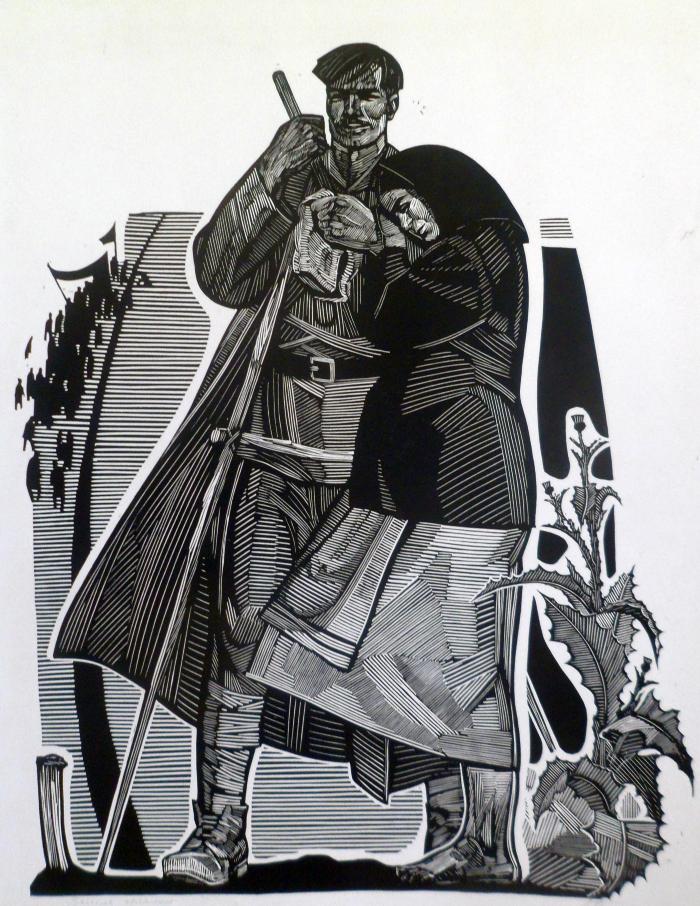
By the spring. Hryhorii Skovoroda. (At the beginnings. Hryhorii Skovoroda)
- ID:
- 766
- Inventory number:
- Гр-80 КН-6187
- Type:
- Graphics
- Material:
- paper
- Techniques:
- linocut
- Dimensions:
- 40x47 cm
- Passport:
- 70x60 cm
- Author:
- Hryhorii Halkin
-
Hryhorii Serhiiovych Halkin was a Ukrainian artist and a member of the Kharkiv organization of the Union of Soviet Artists of Ukraine since 1958. He was born on March 6, 1924 in the village of Hermanivka (now Berestyn district of Kharkiv region). He participated in World War II, received a disability, and was awarded the medals “For Victory over Germany” and “For Courage”. Halkin studied at the Kharkiv Art Institute (1946-1951) under Serhii Biesiedin and Dmytro Shavykin. He lived in Kharkiv and worked in the fields of easel and monumental painting and easel graphics. From 1951, he participated in republic exhibitions, in all-Union exhibitions from 1957, and in foreign exhibitions from 1962 (in particular, in the USA in 1963). His personal exhibitions were held in Kharkiv and Zhdaniv (now Mariupol) in 1974. Halkin's famous works include the easel paintings "Illya Repin in Ukraine" (1954), "Fort of Taras Shevchenko" (1959), "Bandurist" (1960), the monumental collaborative paintings "Mining Rescue Service" (panel, 1957, tempera, House of Technology in Donetsk), a painted frieze (1960, House of Culture "Coal Donbas" in Horlivka), "Art" (1971, Palace of Culture of the city of Komunarsk, Luhansk region), and others. He died in Kharkiv on January 16, 2005. His works are in the Kharkiv Art Museum, Lviv Art Museum, National Art Museum, and Kharkiv Art Gallery.
- Preservation:
- complete preservation
- Location:
- unknown
- Provenance:
- Donated to the museum by artist Halkin H.S. Act No. 1945 dated 08/20/1976.
- Date of record to the inventory book:
- 15.01.1981