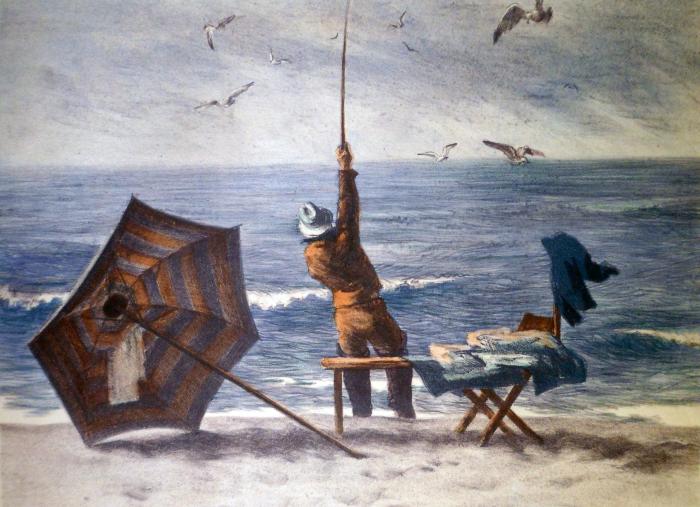
Маєток Сутро
- ID:
- 309
- Інвентарний номер:
- Ж-309 КН-12616
- Тип:
- Живопис
- Матеріал:
- картон
- Техніка:
- олія
- Розмір:
- 87x63 см
- Автор:
- Віктор Арнаутов
-
Viktor Mykhailovych Arnautov was a monumental artist, painter, graphic artist, and a member of the Union of Soviet Artists of Ukraine. He was born on 23 November 1896 in Uspenivka, Katerynoslav Governorate (now Zaporizhzhia region, Ukraine). In his youth, he lived in Mariupol, where he graduated from Oleksandrivska Men’s Gymnasium. He was a participant in the Civil War and emigrated in 1920. From 1925, he lived in San Francisco (USA), where he studied at the California School of Fine Arts until 1929. His teachers included R. Stackpole, G. Piazzoni, Lee Randolph, V. Tarasov, and Diego Rivera. Between 1929 and 1931, he worked in Mexico under the guidance of the monumental artist Diego Rivera. In the early 1930s, he returned to the United States and taught at the California School of Fine Arts. From 1936, he was a lecturer at Stanford University, where he became a Distinguished Professor in the Faculty of Arts. In 1963, he moved to the USSR and got Soviet citizenship. From 1963 to 1972, he worked in Mariupol (then Zhdanov). He began participating in exhibitions in 1931, on the republic level in 1967, and on the international level in 1969. In the USA, he created murals at George Washington High School (1937); in Mariupol, he created monumental panels for the facade of the Central Post Office (1964), at School No. 54 (1965), and the interior of the Mariupol airport – "From the Scythians to Space" (1968–1970). Among his paintings are "Unemployed Mother" (1937), "Self-Portrait" (1941), and others. He passed away on 22 March 1979 in Leningrad (now Saint Petersburg) and was buried in Mariupol.
- Стан збереженості:
- Смуги та плями потертості по всьому зображенню
- Місце знаходження:
- невідомо
- Провенанс:
- Передано автором. Акт №421 від 21.11.1967 р.
- Дата запису в інвентарну книгу:
- 12.11.1981