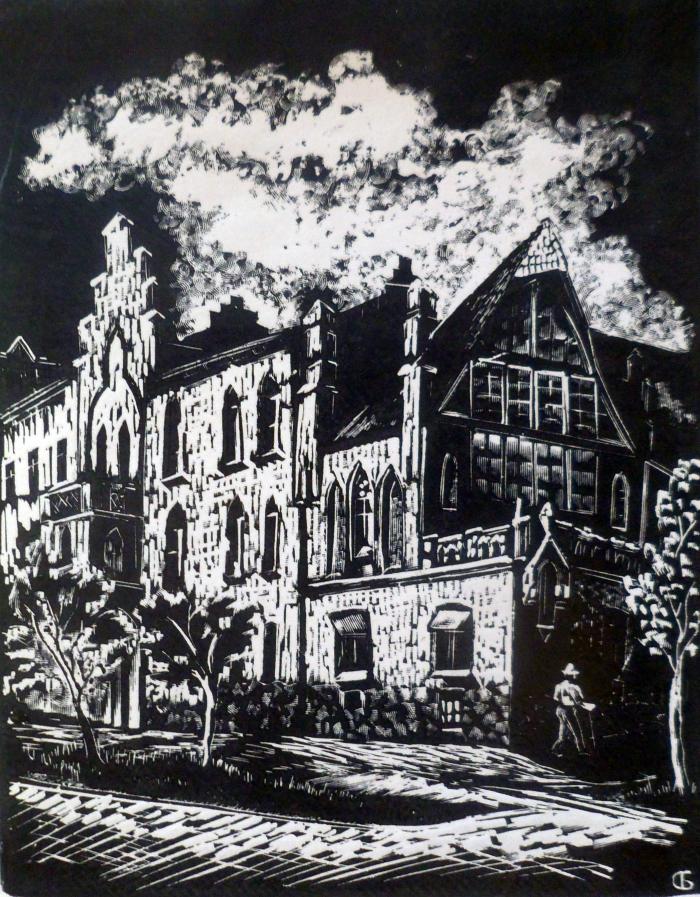
Oborogy (enclosure for cattle)
- ID:
- 1075
- Inventory number:
- Гр-388 КН-12622
- Type:
- Graphics
- Material:
- paper
- Techniques:
- engraving on cardboard
- Dimensions:
- 11.5x17 cm
- Author:
- Stefaniia Gebus-Baranetska
-
Stefaniia Mefodiivna Gebus-Baranetska was a Ukrainian graphic artist. Born on December 9, 1905 in Przemysl, now Poland, she graduated from the Lviv School of Painting of O. Novakivsky (1928) and the Lviv Polytechnic Institute (1933). Her teachers by profession were O. Novakivskyi, O. Kurylas, and L. Tyrovych. Working in the field of easel graphics, she created over 300 graphic works dedicated to Ukrainian folk life, motifs of literary classics, architecture of Lviv, as well as bookplates, ethnographic sketches, and ethnographic essays. She was a member of the Union of Artists of Ukraine (1958) and an Honored Artist of the Ukrainian SSR (1972). Gebus-Baranetska participated in foreign (1938), republic (1946), and all-Union (1960) exhibitions. Her main works include the series "Folk Dances" (1937-1940), "Architectural Motifs" (1938), "Collective Farm Life" (1947); the engravings "Mother", "Bandurist" (1940), "Innovator of Production" (1948), "Industrial Lviv" (1949), "Kosovo Carpet Weavers", "Kosovo Potters" (1956), "House-Museum of Mark Cheremshyn" (1957), "Hutsul Violinist" (1958), the triptych "Amateur Art of Hutsuls (Musicians)" (1960), "Cossack Mamai", "Monument to T. Shevchenko in Kyiv" (1961), "Seasons of the Collective Farmer", "A. Dovbush” (1963), “Kobzar”, “I was Thirteen”, “Katerina” (1964), “Folk Ceramics” (1965), “Dance of the Rebels” (1966), and “Spring Festival in the Hutsul Region” (1969). Her works are kept in museums of Ukraine and Russia. She lived and worked in Lviv and died on March 22, 1985.
- Date of creation:
- 1938
- Preservation:
- complete preservation
- Location:
- unknown
- Provenance:
- Recorded in the inventory on 01/29/1969. Source of income is not specified.
- Date of record to the inventory book:
- 09.11.1981